

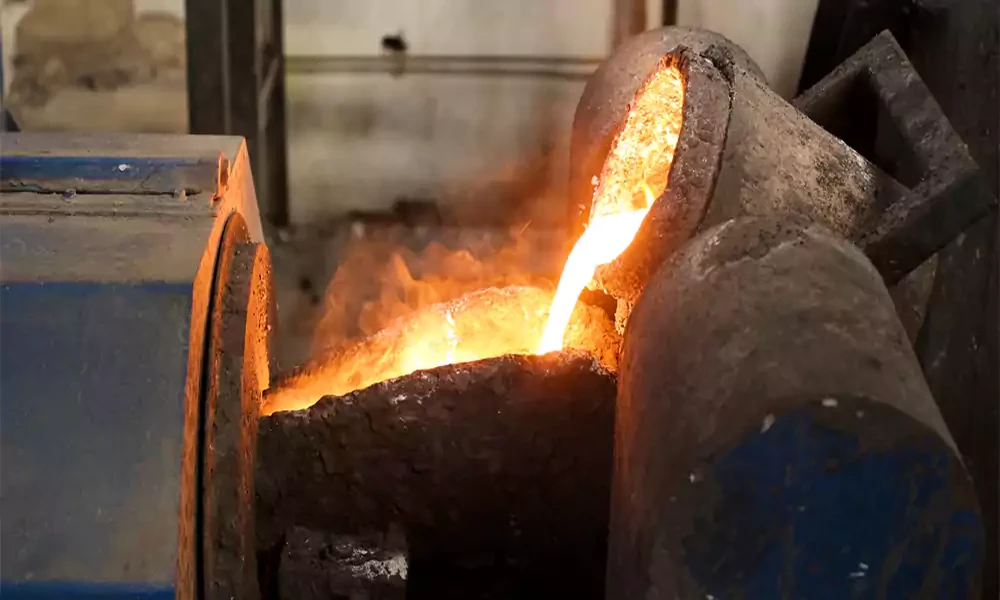
Centrifugal casting occupies a specific and valuable niche in the foundry industry that neither sand casting nor die casting can serve as effectively. For cylindrical and axisymmetric parts requiring dense, porosity-free structure, fine grain, and superior mechanical properties compared to statically cast equivalents, the centrifugal process is often the optimal choice regardless of the additional process complexity it involves. Understanding the physics behind the process and the specific product categories where it delivers compelling advantages helps US procurement teams and design engineers identify when specifying a centrifugal casting manufacturer is the right approach.
How Centrifugal Casting Works
The centrifugal casting process introduces molten metal into a rotating mold, where centrifugal force distributes the metal against the mold wall and maintains it there as solidification occurs. The rotation generates a centrifugal force field that is typically 60 to 100 times the force of gravity at the mold wall, driving lighter impurities, slag inclusions, and gas porosity toward the bore of the casting where they can be machined away, while dense, sound metal solidifies against the outer mold surface that forms the component’s critical working surfaces.
Horizontal centrifugal casting is used for long cylinders, pipes, and tubes whose length-to-diameter ratio makes vertical spinning impractical. The mold rotates on a horizontal axis, with metal introduced through the end or through a pouring spout that traverses the mold length. Centrifugal casting services using vertical spinning are preferred for rings, flanges, and shorter cylinders where the vertical axis geometry better serves the part’s proportions.
Why Centrifugally Cast Parts Often Outperform Static Castings
The mechanical advantages of the centrifugal casting process relative to static sand or permanent mold casting are significant and consistent. The centrifugal force during solidification produces a denser, finer-grained structure with fewer inclusions and gas pores than static casting of the same alloy and geometry. This translates into measurably higher tensile and yield strength, better fatigue resistance, and improved pressure tightness that is particularly important in fluid-handling applications.
For pressure vessels, hydraulic cylinders, pump sleeves, bearing housings, and other components that must contain pressurized fluids reliably over long service lives, the freedom from the internal porosity that plagues many static castings makes the centrifugal casting foundry product the specification choice even at a higher per-piece cost than sand cast alternatives, because the cost of a field failure in a pressure-critical application far exceeds any casting cost savings.
Materials Suited to Centrifugal Casting
Centrifugal castings are produced from a wide range of ferrous and non-ferrous alloys. Iron alloys, including gray iron, ductile iron, austenitic iron, and Ni-Resist, are among the most commonly centrifugally cast materials for industrial pipe, sleeve, and roll applications. Steel and stainless steel centrifugal castings serve high-temperature and corrosion-resistant applications in petrochemical, power generation, and food processing industries. Non-ferrous alloys including bronze, brass, copper, and aluminum are centrifugally cast for bearing bushings, gear blanks, and other applications where the alloy’s tribological or electrical properties make it the right material choice.
What to Look for in a Centrifugal Casting Company
A centrifugal casting company capable of producing quality parts for demanding applications maintains close control over metal temperature, mold rotation speed, and pouring rate, since all three variables interact to determine the final casting’s quality. Mold preparation, including proper preheating and coating to control the solidification rate and surface quality of the casting, is equally important. And post-casting inspection capability, including ultrasonic testing for internal discontinuities and hydrostatic pressure testing for pressure-critical parts, provides the assurance that the centrifugal process’s inherent quality advantages have been fully realized in the specific production lot.
Metal Casting Company Selection for Centrifugal Applications
The metal casting company that serves centrifugal casting requirements most effectively combines centrifugal process expertise with in-house machining capability, since the majority of centrifugal castings require bore machining to remove the impurity-concentrated inner surface and OD machining to achieve the dimensional accuracy that finished component tolerances require. A single source for casting and machining simplifies quality accountability and eliminates the logistical complexity of shipping heavy cylindrical castings between facilities for sequential operations.
